
The global infrastructure landscape has undergone a paradigm shift, placing multi-regional operational compliance, rock-solid security protocols, and automated vertical scaling at the center of modern architecture. Finding the best cloud server hosting for businesses is no longer just a standard operational choice; it represents a foundational strategic asset that directly dictates corporate agility, data sovereignty compliance, and engineering performance levels. This comprehensive cloud server hosting provider review 2026 offers an in-depth, technical analysis of standard vs. enterprise infrastructure models to assist modern organizations in selecting optimal deployment pipelines.
When engineering high-availability platforms, technology leaders are consistently faced with the classic architectural dilemma: Cloud Hosting vs Dedicated Server for business models. Standard generic cloud environments provide unparalleled convenience through immediate, API-driven deployment capabilities, but often introduce unpredictable multi-tenant performance degradation and subtle, variable cost structures. Conversely, legacy single-tenant frameworks provide robust hardware guarantees, yet lack the automated resilience inherent in modern configurations. The ideal 2026 deployment topology frequently bridges this division, combining premium single-tenant bare metal resources with robust hypervisor layers to construct high-performance environments engineered specifically to handle modern operational challenges.
What Makes Great Cloud Server Hosting for Businesses?
Evaluating an enterprise-grade digital infrastructure ecosystem requires moving beyond marketing buzzwords and focusing strictly on verifiable performance indicators and security frameworks. To secure the best cloud server hosting for businesses, technical decision-makers must evaluate potential infrastructure partners across several core operational dimensions:

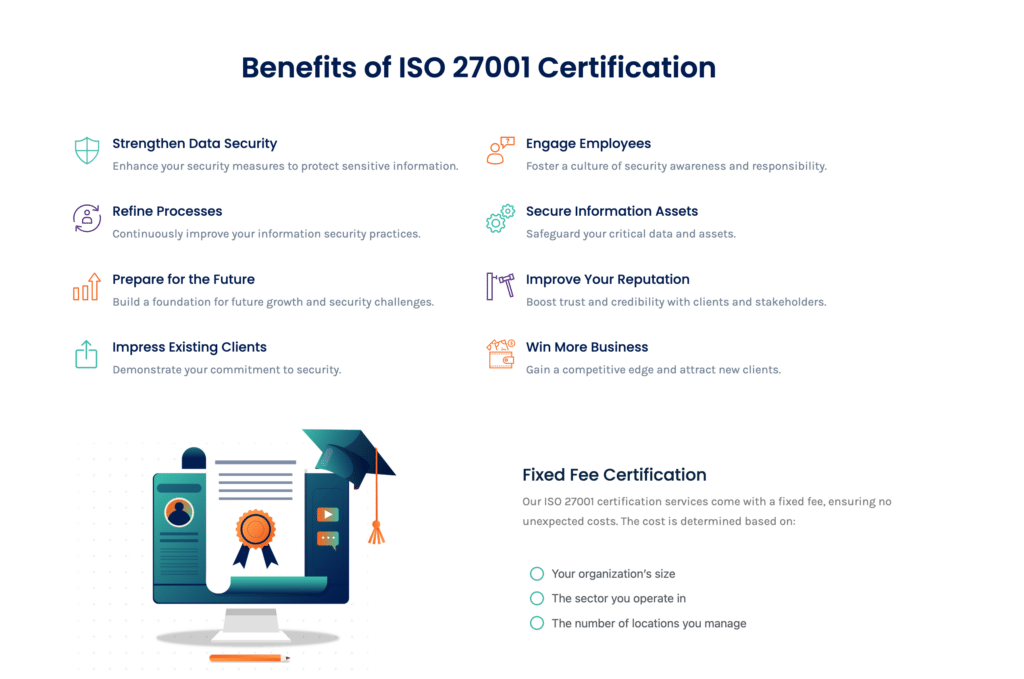
- Tier IV Data Center Architecture & International Certifications: Elite environments must operate from facilities certified to rigorous international operational benchmarks. These spaces guarantee comprehensive physical and network redundancy across all power grids, environmental control loops, and active networking pathways, safeguarding mission-critical database clusters against localized hardware or utility disruptions.
- Guaranteed Operational Availability (99.993% Uptime): A verified 99.993% availability threshold establishes a strict ceiling on corporate risk profiles. Mathematically, an uptime metric of 99.993% permits a maximum of only 36.79 minutes of total cumulative downtime per calendar year. This standard ensures consistent operational readiness for real-time transactions, gaming frameworks, and APIs.
- Granular Multi-Tenant Isolation & Perimeter Defense: True enterprise-ready networks require advanced hypervisor isolation protocols alongside proactive scrubbing centers. Implementing strict automated monitoring systems, internal firewalls, and manual verification procedures for anomalous orders minimizes the threat of shared-resource vulnerabilities and protects crucial IP reputations.
- Developer Integration Capabilities & API Provisioning: Modern operations depend heavily on seamless engineering integration. High-performing business setups must feature programmatic command-line tooling, comprehensive system access, native support for containerized systems, and flexible storage systems, empowering technical teams to deploy code rapidly and safely.
⚙️ Bypass the friction of manual data migration. Let our senior engineering team handle your entire layout migration with absolute data integrity and zero operational downtime. Contact our specialists today to map out your infrastructure blueprint.
Corporate Distinction: Cloud Platform of the Year
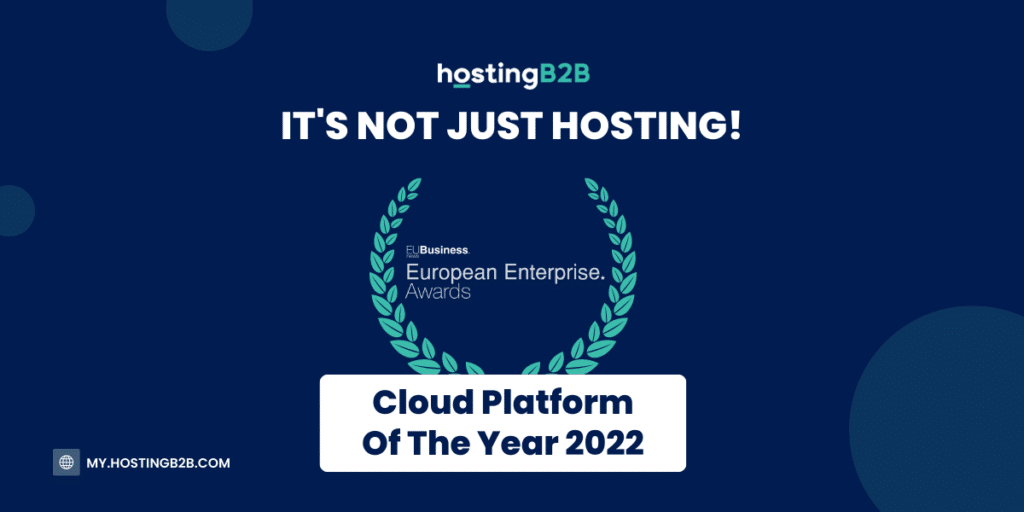
Demonstrating a strong commitment to premium infrastructure standards, HostingB2B officially secured the prestigious Cloud Platform of the Year distinction at the European Enterprise Awards. The European Enterprise Awards aim to spotlight businesses and individuals who drive economic growth in Europe, while celebrating their contributions and providing them with well-deserved recognition.
For modern corporations, this specific validation highlights a provider’s proven capacity to maintain rigorous operational compliance across challenging economic spaces, deploy resilient multi-regional node clusters, and back every deployment with expert, human-led technical oversight instead of automated response queues.
Global Reach and Strict Data Sovereignty
In 2026, the physical location of your deployment architecture dictates your legal compliance framework and directly affects your corporate operational risk. Enterprise cloud server hosting requires a provider capable of handling strict global data protection laws, such as Europe’s GDPR, while simultaneously maintaining low-latency network routes across multiple continents.
When evaluating cloud server hosting for growing businesses, physical data presence and industry experience remain the ultimate competitive differentiators:
- 15 Years Hosting iGaming Platforms: Running digital systems for the highly regulated iGaming sector requires flawless security, continuous uptime, and advanced fraud mitigation. A proven fifteen-year track record in this demanding vertical ensures your business infrastructure is managed by engineers accustomed to zero-downtime execution.
- Compliance Across 20+ Jurisdictions: True data sovereignty means keeping digital assets physically located exactly where regional laws demand. Seamless multi-jurisdictional architecture supports specialized local hosting options across Europe, Cyprus, the UK, and the UAE, keeping your storage layouts aligned with shifting global data regulations.
- Global Footprint Across 3 Continents: Multi-regional businesses require international deployment pipelines. Spanning infrastructure nodes across three separate continents enables corporations to construct localized web platforms, secure cross-border user portals, and scale computing workflows near primary consumer bases.
How to Choose the Best Cloud Provider
To assist technical leads in performing a systematic best cloud server hosting comparison 2026, the following framework categorizes standard shared instances against premium enterprise-grade setups across key infrastructure pillars:
How to Choose the Best Cloud Provider
1. Core Compute Resources
When evaluating a cloud provider, you must look closely at how they allocate physical hardware. Standard Shared Infrastructure relies on over-allocated, multi-tenant virtual slices subject to neighboring performance impacts (“noisy neighbor” syndrome). For business-critical operations, you should look for providers offering Enterprise Dedicated Infrastructure. This features fully dedicated physical resources with guaranteed hypervisor-level isolation, ensuring your applications always have access to the exact vCPU and RAM thresholds you pay for.
2. Storage Array IOPS
Data-intensive applications demand high input/output operations per second (IOPS). Standard Shared Infrastructure frequently uses shared flash storage arrays that experience variable read/write response latencies during peak hours. To prevent performance bottlenecks, choose a provider that deploys dedicated NVMe storage systems configured with redundant backup structures, delivering maximum parallel processing speeds and hardware failure protection.
3. Network Availability & Routing
A remote desktop or cloud application is only as good as the network connecting it. Standard Shared Infrastructure utilizes standard public internet pathways vulnerable to common routing changes, leading to unpredictable latency spikes. Conversely, Enterprise Dedicated Infrastructure provides premium multi-homed carrier backbones backed by full DDoS mitigation.
At HostingB2B, we bridge this gap by routing all remote desktop traffic through our own enterprise-grade network infrastructure, ensuring your virtual instances remain insulated from public network volatility. By partnering with elite tier-1 telecom providers across our global data centers, we maintain highly optimized routing paths tailored specifically to reduce round-trip times (RTT) for distant remote workers. This meticulous approach to network engineering guarantees that your critical business operations benefit from an uninterrupted, low-latency connection profile 24/7/365.
4. Compliance & Security Audits
If your business operates in highly regulated fields like iGaming or Fintech, compliance is non-negotiable. Standard Shared Infrastructure usually offers only basic regional compliance frameworks with generalized data privacy configurations. You should prioritize Enterprise Dedicated Infrastructure that delivers complete multi-jurisdictional compliance catering to strict industry regulations, supported by international standards like ISO 9001 and ISO 27001.
5. Technical Support & SLA
When infrastructure issues arise, every minute of downtime equals lost revenue. Standard Shared Infrastructure providers often cut costs by providing automated chatbot assistance or multi-tiered, delayed email ticketing. Enterprise Dedicated Infrastructure, on the other hand, guarantees an ironclad Service Level Agreement (SLA) with immediate access to senior systems and network engineers via 24/7/365 rapid response times.
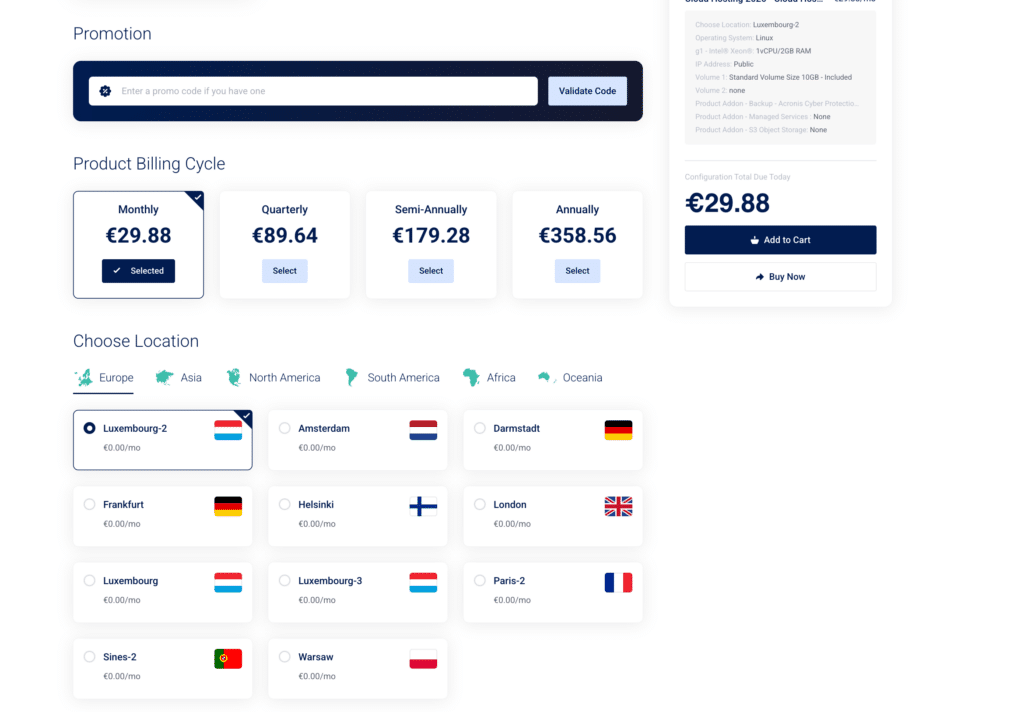
An analysis of this architectural breakdown reveals that a true enterprise configuration completely eliminates the volatile resource throttling and “noisy neighbor” effects inherent in basic setups. By moving away from rigid, legacy structures, modern infrastructure platforms introduce highly flexible and predictable billing cycles—ranging from scalable monthly plans starting at an accessible €29.88 to quarterly, semi-annual, and structured annual commitments. This transparent financial framework allows early-stage startups to tightly manage their initial operational runway, while simultaneously empowering expanding enterprises to accurately forecast their global computing overhead without encountering hidden data transfer fees or variable hypervisor costs.
Beyond financial predictability, the ultimate competitive advantage lies in the strategic deployment of an expansive, multi-continental edge network spanning Europe, Asia, North and South America, Africa, and Oceania. Within the crucial European sector, technical teams can instantly provision workloads across high-density, low-latency nodes situated in premier financial and regulatory hubs, including Luxembourg, Amsterdam, Frankfurt, London, Paris, and Warsaw. This dense geographical distribution allows corporations to seamlessly achieve bulletproof data sovereignty—strictly aligning with rigorous localized mandates like GDPR by locking core databases within specific geographic borders—while drastically reducing latency by executing containerized microservices as close to the end-user base as physically possible.
Best Cloud Hosting Solutions For Specific Needs
Selecting an ideal digital architecture depends heavily on a company’s specific phase of growth, development workflows, and target regulatory compliance landscapes. Reviewing the top cloud hosting companies ranked by strategic application reveals how tailored setups meet diverse corporate demands:
High-Agility Frameworks: Cloud Server Hosting for Startups
Early-stage operations demand rapid development environments paired with clear, predictable operational spending models. Utilizing flexible cloud server hosting for startups allows teams to validate software products without incurring large upfront capital expenditures. The focus must remain on adopting tailored, transparent business cloud hosting plans that protect initial runway while providing clear vertical pathways for sudden traffic spikes.
Performance-Critical Workflows: Cloud Hosting for Developers and Teams
Engineering departments require deep system-level control, programmatic automation capabilities, and consistent raw performance. Specialized cloud hosting for developers and teams balances high-speed build processing with secure staging workflows. Incorporating granular VPS Hosting instances allows teams to test isolated codebases, run custom microservice configurations, and maintain steady development pipelines without impacting production environments.
Strict Enterprise Demands: Corporate & Managed Systems
Large-scale corporations operating across complex international regulatory spaces require absolute performance consistency and strict data privacy. Relying on advanced enterprise cloud server hosting guarantees specialized single-tenant security pools and dedicated hardware resources. For entities lacking massive in-house infrastructure departments, employing a comprehensive managed cloud server hosting for business strategy unloads day-to-day patching, security monitoring, and configuration tuning onto dedicated external infrastructure professionals, allowing internal teams to focus on core business objectives.
Conclusion
Sustaining a clear competitive advantage in 2026 requires moving away from over-allocated public cloud environments and embracing highly secure, robust infrastructure models. Selecting the best cloud server hosting for businesses serves as a critical operational decision that ensures application performance stability, predictable corporate budgeting, and comprehensive data compliance across international borders.
By prioritizing Tier IV data center certifications, demanding a strict 99.993% uptime SLA, and aligning infrastructure choices with specific corporate development models—whether leveraging agile virtual servers or deploying raw, high-performance Dedicated Servers—organizations can build a resilient digital foundation capable of scaling safely through 2026 and beyond. Where the long-term plan is to own that hardware rather than rent it indefinitely, Lease-to-Own (LTO) servers make the shift possible without a single large capital outlay.
FAQ
The optimal framework for highly regulated environments is a dedicated enterprise configuration operating out of verified Tier IV data centers. This approach guarantees full data isolation, physical tracking options, and compliance with specialized international frameworks, avoiding the security concerns often found in standard multi-tenant setups.
A 99.993% uptime commitment guarantees that an infrastructure provider limits total cumulative service downtime to a maximum of just 36.79 minutes per year. This high level of service ensures that critical transactional databases, trading applications, and user-facing portals remain accessible during peak traffic windows.
The main benefits include instant, flexible hardware scaling, reduced upfront infrastructure costs, and global delivery frameworks. The primary challenge stems from variable billing structures and performance variations found in low-tier shared platforms. Moving toward specialized, fixed-price business configurations effectively eliminates these financial and technical variables.
Dedicated virtual structures provide development teams with isolated, high-speed storage spaces, dedicated memory allocations, and full configuration control. This ensures that resource-heavy software compilation steps, testing pipelines, and live app deployments run at peak efficiency without experiencing multi-tenant performance slow-downs.