In the digital-first economy, the physical location of your data is not merely a technical detail—it is a cornerstone of your business continuity plan. For many growing enterprises, the transition from an on-premise server room to a professional datacenter environment is the single most significant upgrade in their operational lifecycle. While both house hardware, the difference between Datacenter vs. Server Room environments is defined by resilience, compliance, and the elimination of single points of failure.
Professional facilities provide industrial-grade cooling and redundant power systems that a standard office closet simply cannot replicate. By migrating to a Tier-certified facility, you ensure your mission-critical applications maintain a 99.993% uptime, protecting your revenue from unpredictable local hardware failures or power outages. This strategic shift allows your internal IT team to stop troubleshooting power cables and start focusing on core business growth and innovation.
Datacenter vs. Server Room: The Structural Divide
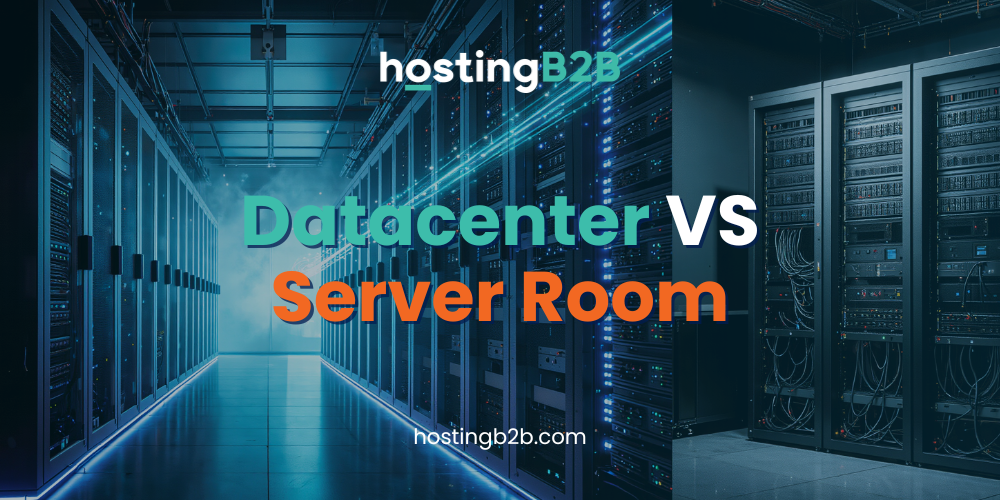
A server room is typically a converted office space, often lacking the structural reinforcement and environmental controls required for high-density computing. In contrast, a datacenter is a purpose-built fortress designed to withstand natural disasters, power grid collapses, and sophisticated physical breaches. The core difference between data center and server room setups lies in the “Tier” classification. While a server room might achieve 98% uptime, a Tier III datacenter guarantees 99.993% availability. This translates to less than 1.6 hours of downtime per year, compared to the potential days of outages a simple office power failure could cause.
Data Center Components and Technical Requirements
To provide a true enterprise-grade environment, data center components must adhere to rigorous international standards (ISO 27001, TIA-942). Each item has specific requirements that far exceed what is possible in a standard office building.
Power Distribution and $N+1$ Redundancy
- Requirements: Dual utility feeds from independent substations.
- Infrastructure: Industrial-grade Uninterruptible Power Supplies (UPS) filtered through flywheels or battery banks to normalize voltage spikes.
- Emergency Backup: On-site Diesel Generators with fuel reserves capable of powering the entire facility for 48–72 hours without refueling.
Precision Climate Control (HVAC)
- Requirements: Maintaining a constant temperature of $22^\circ\text{C} \pm 2^\circ$ and humidity at $50\%$.
- Infrastructure: CRAC (Computer Room Air Conditioning) units utilizing N+1 redundancy. In a professional datacenter, “Hot Aisle/Cold Aisle” containment is mandatory to prevent the thermal mixing that leads to hardware degradation.
High-Density Racking and Structural Load
- Requirements: Floor loading capacity exceeding $1,200 \text{ kg/m}^2$.
- Infrastructure: Seismic bracing and raised flooring systems (600mm to 1000mm) that allow for efficient under-floor airflow and organized cable management, separating power from data to prevent electromagnetic interference.
Fire Suppression and Gas-Based Extinguishing
- Requirements: Zero-water fire suppression.
- Infrastructure: Systems such as FM-200 or Novec 1230. These gases chemically interrupt the combustion process without damaging sensitive circuitry, allowing the hardware to remain operational even during a suppression event.
No Provider Is an Island: The Power of the Ecosystem
As we have previously established, a top-tier provider cannot exist in isolation. Connectivity is the lifeblood of infrastructure. A datacenter without a robust peering ecosystem is merely a sophisticated warehouse. To be truly “Enterprise-Grade,” a provider must be integrated into a global fabric.
Carrier Neutrality and Multihoming
A premium provider must offer access to multiple Tier-1 carriers (like Lumen, Telia, or GTT). This prevents a “blackout” if a single ISP suffers a trans-oceanic cable cut.
Strategic Peering and IXP Integration
Integration with Internet Exchange Points (IXPs) ensures that traffic takes the shortest possible path. By peering directly with major ISPs and content providers, we reduce the “hops” your data takes, significantly lowering latency.
Compliance and Jurisdictional Synergy
True infrastructure excellence requires alignment with local and international law. A provider must operate within “Data-Safe” jurisdictions that offer legal protections for digital assets, bridging the gap between technical uptime and legal security.
How Important Is Location When Choosing a Server?
The data center location is the primary determinant of your user experience. It influences everything from SEO rankings to transaction speeds in high-frequency environments.
- Latency (The Speed of Light Constraint): No matter how fast your CPU is, physics dictates that data takes time to travel. Placing your VPS hosting closer to your users (e.g., Cyprus for Mediterranean traffic) reduces Round Trip Time (RTT) and improves overall performance.
- Edge Sovereignty: For industries like iGaming, Forex, and Fintech, hosting in specific jurisdictions (such as Malta or Curaçao) is often required for licensing and regulatory compliance.
- Risk Mitigation: Deploying infrastructure in geologically stable regions helps reduce the risk of downtime caused by natural disasters, outages, or regional disruptions.
- Network Quality & Peering: Premium locations such as Frankfurt, Amsterdam, or Dubai provide better connectivity, strong peering agreements, and more stable routing, resulting in lower latency and packet loss.
- Data Privacy & Compliance: Server location determines how data is handled. Hosting within the EU supports GDPR compliance, while other regions may offer different levels of data flexibility.
Choosing the right server location is a strategic decision that directly impacts performance, compliance, and long-term business continuity. For enterprises specializing in iGaming and Fintech, our Tier-certified facilities in Malta and Curaçao offer the perfect synergy of specialized licensing support and low-latency connectivity. By aligning your infrastructure with these high-value jurisdictions and your specific target audience, you ensure a seamless user experience that meets even the most stringent regulatory requirements. This localized approach not only reduces latency but also provides the operational stability necessary to scale your digital assets in a competitive global market.
Data Center Components: What Makes a Data Center Work
The operational integrity of a modern data center is a sophisticated symphony of engineering systems, where every component functions in strict synergy to ensure absolute fault tolerance. Unlike a server room, where hardware often struggles against an unsuitable environment, a professional Data Center (DC) dictates its own operating conditions. It is not merely a building but a high-tech organism where “physics” (power and cooling) is inextricably linked with “logic” (network connectivity). To understand why a 99.993% uptime is physically impossible in an office closet, one must deconstruct the three fundamental pillars upon which any Tier-certified architectural framework rests.
- Power Sovereignty and Advanced Filtration. At the heart of a professional facility is an Uninterruptible Power Supply (UPS) system built on $N+1$ or $2N$ redundancy principles. This involves more than just large battery banks; it includes industrial-grade flywheels or lithium-ion arrays that instantaneously smooth out voltage spikes and harmonic distortions from the municipal grid. In the event of a total utility failure, Automatic Transfer Switches (ATS) migrate the entire load to industrial diesel generators capable of sustaining the facility for days.
- Precision Climate Control and Airflow Management. Cooling in a professional data center is not just about “cold air”—it is about the precise management of pressure and directional flow. The deployment of CRAC (Computer Room Air Conditioning) units allows for temperature maintenance within a fraction of a degree while strictly controlling humidity to prevent static discharge or corrosion. By utilizing “Hot Aisle/Cold Aisle” containment technology, the facility ensures that exhaust heat from servers never mixes with the chilled supply air.
- Gas-Based Suppression and Early Detection Systems. Data security within a DC includes protection against elemental threats, where fire is the primary adversary. Instead of water-based sprinklers, which are catastrophic for electronics, professional facilities use VESDA (Very Early Smoke Detection Apparatus) to sample the air for microscopic combustion particles long before visible smoke appears. If an ignition occurs, a gaseous suppression system (such as Novec 1230 or FM-200) is deployed to chemically interrupt the fire without reducing oxygen to unsafe levels for humans or leaving any residue.
Investing in these specific components defines the strategic boundary between “storing data” and “guaranteed service availability.” When we discuss Data Center Components, we are describing the systematic elimination of the human factor and the transformation of an unpredictable external environment into a strictly controlled vacuum. For a growing enterprise, migrating to such an infrastructure means delegating physical risk; instead of battling leaky office AC units or power surges, the company gains a standardized environment where every bolt and cable complies with international TIA-942 standards. This shift transforms IT from a series of potential points of failure into a rock-solid foundation for global scaling.
Global Footprint: The HostingB2B Strategic Edge
HostingB2B doesn’t just provide “servers”; we provide strategic gateways to global markets. Our chosen data center locations are selected for their unique geopolitical and technical advantages:
- Cyprus & Malta: The premier gateways to the EU and Middle East, offering robust GDPR compliance and world-class connectivity.
- Dubai (UAE): The technological heart of the MENA region, perfect for low-latency reach into emerging markets.
- Curacao: A strategic hub for the international iGaming industry, providing specialized licensing and infrastructure support.
- United Kingdom & Germany: The core processing hubs for European finance and SaaS enterprise.
Elevate Your Infrastructure with HostingB2B VPS Servers
Building an on-premise facility that meets the data center components listed above requires millions in CAPEX. For the modern enterprise, HostingB2B VPS servers offer a more intelligent path.
Our VPS solutions are hosted exclusively in Tier III+ facilities, providing you with the power of a multimillion-dollar datacenter at a scalable monthly cost. By utilizing HostingB2B VPS servers, you inherit our global peering network, our redundant power systems, and our strategic geographic reach. Whether you are scaling an e-commerce platform or a high-load database, our infrastructure is built to ensure you never have to worry about what’s happening in the “server room” again.
FAQ
What is the primary difference between data center and server room security?
A server room usually relies on office-level security (a locked door). A datacenter uses “Defense in Depth,” including 24/7 on-site security teams, biometric scanners, and man-traps.
Why should I care about “Carrier Neutrality” in a datacenter?
It prevents “Vendor Lock-in.” If one ISP raises prices or has poor routing to a specific country, a carrier-neutral provider like HostingB2B can instantly switch to a better-performing alternative.
Can I customize my HostingB2B VPS location?
Yes. We allow you to deploy resources across our global network (Cyprus, UAE, Malta, etc.) to ensure your data is exactly where your customers are.
How does the cooling system in a professional facility protect my hardware?
The main difference between data center and server room cooling is precision. While a server room might rely on standard office AC, a datacenter uses CRAC units to maintain specific thermal zones. This prevents “hot spots” that cause hardware to throttle or fail, ensuring your components live longer and perform at peak levels.
Is a Tier III datacenter overkill for a small business?
Not when you consider the cost of downtime. In the datacenter vs. server room comparison, a server room’s 98% uptime can mean 7 days of outages a year. For any business relying on digital sales or internal databases, the stability of a Tier III facility pays for itself by preventing lost revenue during local power or internet failures.
What are the essential data center components for high-frequency trading or Fintech?
For sensitive industries, the critical data center components are low-latency cross-connects, $N+1$ power redundancy, and hardware-level security. These features ensure that transactions are processed in milliseconds without the risk of a single power surge or connectivity drop interrupting a trade.
Why is data center location a critical factor for SEO?
The data center location directly affects “Time to First Byte” (TTFB). Search engines like Google prioritize fast-loading websites. By placing your server in a strategic hub like Cyprus or Dubai, you reduce latency for users in those regions, which can lead to better search rankings and a lower bounce rate.
What happens to my data during a fire in a professional datacenter?
Unlike a server room that might use water sprinklers (which destroy electronics), a professional facility uses gas-based suppression. This is one of the most vital data center components, as it extinguishes fire by interrupting the chemical reaction without damaging your servers or causing any short circuits.
Can I achieve compliance (GDPR/ISO) in a standard server room?
It is extremely difficult and expensive. Most international compliance standards require strict physical access logs and environmental monitoring. By choosing a professional data center location through HostingB2B, you immediately inherit our certifications, making it much easier for your business to pass audits and meet legal requirements.
Conclusion
Ultimately, the transition from a localized server room to a professional, Tier-certified datacenter is a strategic investment that secures the future of your enterprise. By prioritizing architectural superiority and infrastructure resilience, HostingB2B eliminates the technical bottlenecks that often hinder scaling businesses. Our global network ensures that your mission-critical data is not only protected by $N+1$ redundancy but also positioned geographically to deliver peak performance and regulatory compliance. Shifting your operational focus from hardware maintenance to core innovation allows your team to drive growth without the constant fear of downtime. In an era where every millisecond and every percent of uptime impacts your bottom line, a professional infrastructure ecosystem is no longer a luxury, but a necessity. Choosing HostingB2B means choosing a partner dedicated to bridging the gap between technical complexity and seamless business continuity.